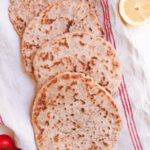
Gluten-Free Sourdough Flatbread
This gluten-free sourdough flatbread has the delightful tang of sourdough and a fluffy, bubbly texture. It's perfect for wraps, pizza crust, or scooping up your favorite soup and dips. This recipe yields soft, flexible flatbreads made on the stovetop. Dairy-free, vegan & nut-free as well!
Servings 4 flatbreads
Ingredients
- 200 g warm water
- 10 g maple syrup or honey
- 8 g finely ground psyllium husk powder or 12g whole psyllium husks
- 10 g olive oil
- 80 g gluten-free sourdough starter I like using active starter or fresh sourdough discard, don't use discard that's too old or it won't have enough activity
- 70 g potato starch
- 30 g tapioca starch you can use any combination of starches that you like, such as tapioca, potato, arrowroot, or cornstarch. The listed combination/amounts was our favorite that we tested.
- 110 g superfine brown rice flour
- 30 g millet flour you can use any combination of whole grain flours you like, such as brown rice, white rice, oat, teff, buckwheat, sorghum, millet, etc. The listed combination/amounts were our favorite that we tested.
- 5 g fine sea salt
Instructions
- Activate the psyllium gel. In a large bowl, whisk together the warm water, maple syrup, and finely ground psyllium husk. Let it sit for 2–3 minutes until it thickens into a gel. If using whole psyllium husk (shells) instead of powder, increase the amount to 12g.200 g warm water, 10 g maple syrup or honey, 8 g finely ground psyllium husk powder or 12g whole psyllium husks
- Add the sourdough starter. Mix olive oil and the active GF starter into the psyllium gel until smooth and well combined.10 g olive oil, 80 g gluten-free sourdough starter
- Mix dry ingredients. In another bowl, whisk together the potato starch, tapioca starch, brown rice flour, millet flour, and salt. Sift the ingredients together if they're clumping at all.70 g potato starch, 30 g tapioca starch, 110 g superfine brown rice flour, 30 g millet flour, 5 g fine sea salt
- Form the dough. Add the dry mixture to the wet and mix well until a soft, pliable dough forms. Knead until it’s smooth and uniform. It should be soft but not sticky.
- Bulk fermentation. Cover the dough and let it rise at room temperature for 2 hours until it is slightly puffy and airy.
- Cold ferment (optional, but recommended). After the initial rise, cover the dough in plastic wrap or something similar and refrigerate the dough overnight (up to 18 hours). This step improves flavor, hydration, and overall dough texture. Let the dough come back to room temperature before shaping.
- Shape the pitas. Divide the dough into 4 equal balls. Cover and let rest for 15–20 minutes. Then, roll each ball into a circle about 1/4 inch (0.5–0.7 cm) thick. If you'd prefer more, smaller flatbreads instead of 4 large ones, divide the dough into small pieces.
- Preheat your pan. Heat a dry cast-iron or nonstick skillet over medium-high heat until thoroughly hot.
- Cook the flatbread. Lightly oil the pan. Place a flatbread on the hot pan and cover it with a lid to trap steam. Cook for 1–2 minutes until bubbles appear and the bottom is golden. Flip and cook the second side for another 1–2 minutes. Optional: Flip again briefly to help it puff more. Remove from the pan and let cool on a paper towel-lined plate while you finish cooking the rest of the flatbreads.
- Prefer the oven? You can also bake the pitas in a preheated oven at 450°F (230°C) for about 5 to 7 minutes, until puffed and lightly golden.
- Store your flatbreads. Keep pitas in the fridge for 1-2 days, wrapped with a plastic film, or freeze in an airtight container/bag. Reheat them in the oven or on a pan with a sprinkle of water to refresh.
Notes
Top Tips for Perfect Pitas:
- Sift dry ingredients to enhance elasticity.
- Fine sea salt improves dough texture.
- Cook on a very hot pan to achieve the best puff and texture.
- Use minimal oil in the pan—too much oil makes the pita gummy.
- Drizzle a little water on the pita while cooking to encourage puffing, and cover the pan with a lid. Gluten-free sourdough dough loves humidity.
- Once cooked, drain excess oil by placing the pita on paper towels, then cool each separately on a cooling rack
